
Most manufacturers begin their Manufacturing Execution System (MES) journey with a specific problem.
A manufacturer needs better downtime tracking. A quality team needs more reliable records. A production team needs to replace paper batch documentation. An operations leader needs clearer visibility across lines, products, or sites.
Solving that immediate problem matters. But the MES platform you choose will shape far more than the first use case. It will influence how easily your operation can adapt to new products, connect to new systems, expand across sites, support regulatory changes, and prepare production data for analytics and AI.
That is why MES selection should not start and end with a feature checklist. The better question is:
Will this MES become a foundation for future growth, or will it become a barrier?
Start with the Future You Are Building Toward
It is natural to evaluate MES software based on today’s pain points. But manufacturing environments rarely stand still.
A few years from now, your company may have more sites, more products, tighter regulatory requirements, new data sources, and new technologies that are not even part of your current roadmap. Your production processes may change. Your reporting needs may expand. Your business systems may evolve. Your leadership team may expect more consistent enterprise visibility across facilities.
An MES that solves one narrow problem today but limits your options tomorrow can create long-term challenges. Early solutions often become later obstacles when they are built around disconnected tools, siloed data, one-off automations, limited business system integration, or custom logic that is difficult to maintain.
Before selecting an MES, define the future system you want to grow into. Then evaluate each platform based on how well it supports that direction.
Ask questions like:
- Can this MES adapt as our products, processes, and sites change?
- Can it connect to the systems we use today and the tools we may need later?
- Can it support both site-level needs and enterprise-level standardization?
- Can it structure production data in a way that supports reporting, analytics, and AI?
- Can we expand functionality over time without rebuilding the foundation?
The goal is not to predict every future requirement. The goal is to avoid choosing a system that blocks future possibilities.
Look Beyond Features to Execution, Orchestration, and Monitoring
MES software is often evaluated by module names: OEE, batch, traceability, SPC, quality, scheduling, work orders, and ERP integration. Those capabilities are important, but they only tell part of the story.
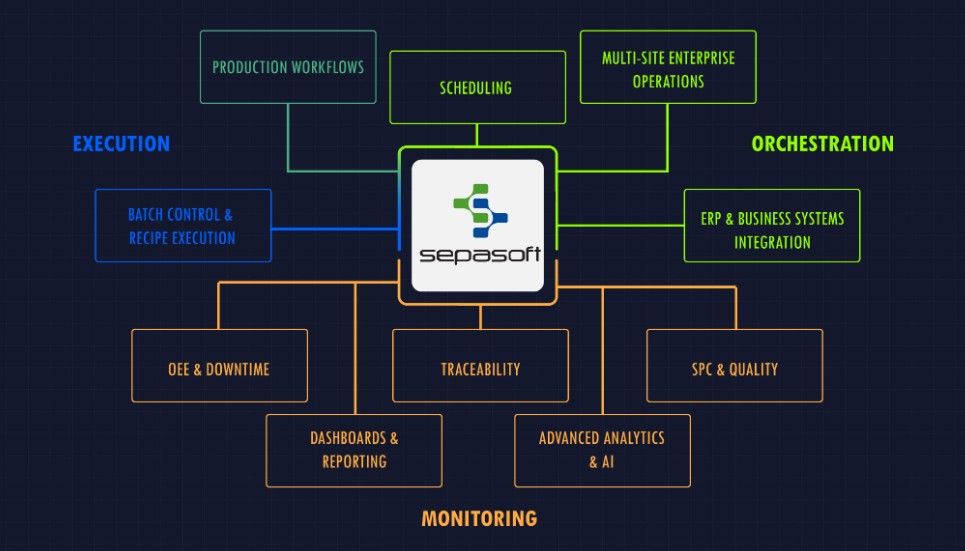
A better way to evaluate those capabilities is through the three-part framework Gartner highlights in its 2025 Market Guide for Manufacturing Execution Systems: execution, orchestration, and monitoring.
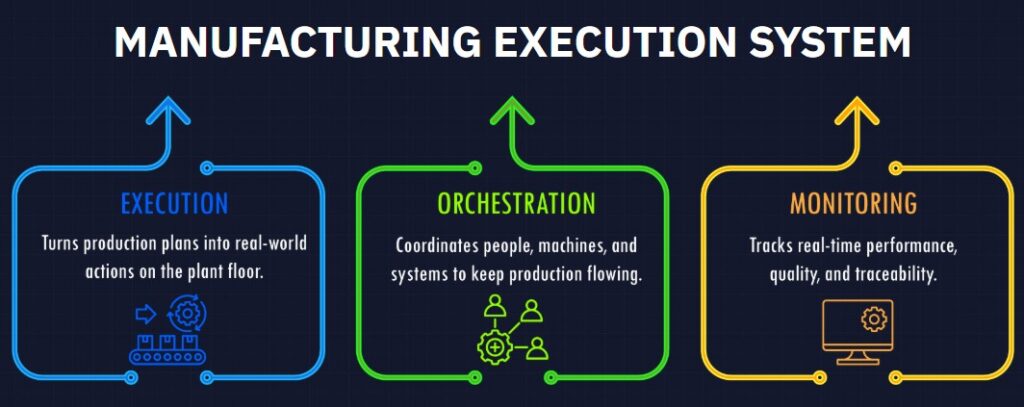
Execution is about helping work happen correctly. This includes guiding operators through procedures, enforcing required steps, capturing values, supporting approvals, and helping prevent skipped steps or undocumented work.
Orchestration is about coordinating the resources, systems, and decisions involved in production. This can include work orders, materials, equipment, labor, schedules, recipes, business system integration, and cross-site alignment.
Monitoring is about tracking what happened, what is happening, and what can be improved. This includes real-time production visibility, historical records, quality data, genealogy, downtime analysis, performance KPIs, and reporting.
A strong MES should not only collect data. It should help coordinate production activity, guide execution, and preserve the context needed to understand what happened later.
Choose a Modular MES Architecture
Many manufacturers do not need every MES function on day one. They may start with OEE and downtime tracking, then expand into batch procedure management, traceability, SPC, changeover, ERP integration, analytics, or scheduling.
That is where modular MES architecture matters.
A modular MES lets manufacturers start with the capabilities that solve their immediate needs while preserving room to expand. This can reduce initial complexity, support phased rollouts, and make it easier to add functionality as operational maturity increases.
But modular should not mean fragmented. Adding new capabilities should not create disconnected systems or separate data models that require constant manual reconciliation. The best modular MES platforms allow manufacturers to expand functionality while maintaining a connected foundation.
When evaluating MES software, ask:
- Can we start with one use case and expand over time?
- Do modules share a common architecture and data model?
- Can new capabilities be added without duplicating data or rebuilding integrations?
- Can different sites adopt functionality at different stages while still supporting enterprise standards?
The right MES should support growth without forcing every decision to be made upfront.
Avoid Systems That Create Connectivity Dead Ends
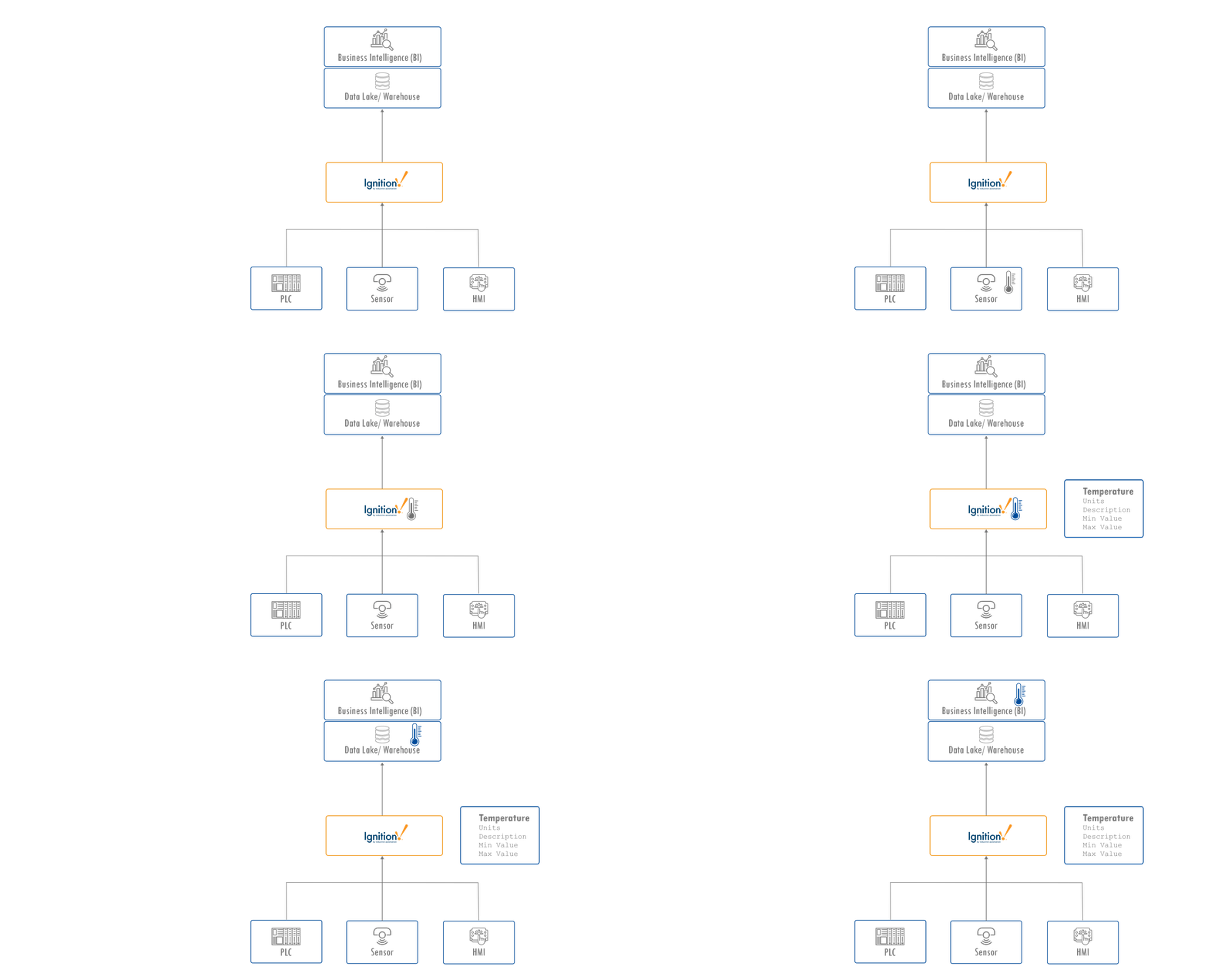
Manufacturing operations depend on many systems working together. ERP systems manage orders, inventory, and business transactions. SCADA and HMI systems provide real-time operational visibility and control. PLCs and automation systems interact directly with equipment. Quality systems, historians, lab systems, reporting tools, BI platforms, and AI tools may all need access to production data.
An MES that cannot connect cleanly to this environment can quickly become another silo.
Integration should be evaluated early in the selection process, not treated as an implementation detail to solve later. A system that requires extensive custom work for basic connectivity may create long-term maintenance challenges, especially as business systems and production needs evolve.
Look for an MES that can connect across business and operational systems while preserving context. Production data is most valuable when it is linked to the order, product, batch, equipment, operator action, downtime reason, quality result, or process condition that gives it meaning.
The question is not simply, “Can this MES collect data?”
The better question is, “Can this MES keep production data connected, contextualized, and usable across the enterprise?”
Make Sure Production Control Can Adapt to Real Operations
Manufacturing rarely follows the perfect path.
Operators encounter exceptions. Equipment behaves unexpectedly. Materials are delayed. Quality checks require additional actions. A batch may need to pause, repeat, or move through an approved deviation path. A schedule may need to shift because a constraint changed.
An MES must support the reality of production, not just the ideal version of the process.
For batch and procedural manufacturing, this is especially important. A strong MES should help separate recipe or procedure logic from equipment control logic so PLCs can stay focused on equipment control while the MES manages recipe flow, operator actions, approvals, documentation, and procedural decisions.
That separation gives manufacturers more flexibility. Process experts can adjust procedural logic without requiring every change to become an automation project. Operators can be guided through required steps. Records can capture what happened, including manual actions and exceptions.
During MES evaluation, ask:
- Can workflows adapt when the process changes?
- Can the system support both automated and manual steps?
- How are operator actions, approvals, and exceptions captured?
- Can the MES support production variations without creating uncontrolled workarounds?
- Does the system help enforce consistency while still allowing approved flexibility?
The best MES platforms help manufacturers maintain control without becoming rigid.
Plan for Growth Across Sites, Lines, and Products
An MES that works for one line may not automatically work across an enterprise.
As manufacturers expand, they often need to balance standardization with local flexibility. Leadership may want consistent reporting, comparable KPIs, shared production models, and enterprise visibility. Individual sites may have different equipment, processes, staffing models, product mixes, or regulatory needs.
That tension should be considered during MES selection.
A scalable MES should help manufacturers standardize where consistency matters while still allowing site-level differences where operations require them. It should support more lines, more products, more demand, and more complexity without forcing every site into an identical structure.
This is especially important for manufacturers trying to benchmark performance across sites. If each facility defines downtime, quality events, production records, and reporting logic differently, enterprise visibility becomes difficult. The MES should help create a consistent foundation for comparison without ignoring the realities of each location.
Ask questions like:
- Can this system support multiple sites without creating disconnected deployments?
- Can we standardize production models, reports, or logic across facilities?
- Can sites maintain necessary local variation?
- Can enterprise teams see consistent performance data across locations?
- Can the platform expand as production volume, product complexity, and operational demands increase?
A future-ready MES should help growth feel coordinated, not chaotic.
Think Beyond Data Collection
Many manufacturers already collect large amounts of production data. The problem is that the data is often scattered, inconsistent, or missing context.
A machine tag may show a value, but not the product being made. A downtime event may be recorded, but not linked clearly to the order, equipment state, operator input, or production condition around it. A batch record may contain important details, but not in a structure that can easily feed dashboards, BI, or AI tools.
For modern manufacturing, the MES should do more than store production data. It should help turn that data into a trusted, contextualized source of operational intelligence.
This matters because analytics and AI depend on data quality and context. If production data needs extensive cleanup before anyone can use it, every reporting, machine learning, or AI initiative becomes slower and less reliable.
When evaluating MES software, ask:
- Is production data structured consistently across sites?
- Is manufacturing logic applied consistently?
- Can BI and AI tools use the data without extensive cleanup?
- Is raw production data linked to product, batch, downtime reason, quality result, and other operational context?
- Are changes or post-production updates reflected in downstream reporting?
A strong MES should prepare production data for the next level of use, not leave future teams to interpret disconnected records later.
Choose an Open, Adaptable Platform
Manufacturing technology will continue to change. New analytics tools, AI applications, automation strategies, regulatory requirements, and enterprise systems will emerge. The MES you choose should be able to connect with that future, not limit it.
An open, adaptable platform gives manufacturers more room to evolve. It reduces the risk of being locked into one narrow path and makes it easier to connect new tools as needs change.
This does not mean every manufacturer needs to build everything custom. In fact, too much customization can create its own long-term burden. The goal is to choose a platform that offers strong out-of-the-box MES capabilities while still allowing flexibility where your operation truly needs it.
A future-ready MES should provide structure without becoming a constraint. It should support standards without forcing unnecessary rigidity. It should connect to today’s systems while leaving room for tomorrow’s technologies.
MES Decisions That Shape Your Future
Choosing MES software is not just a question of whether a platform has the right features. Most vendors can say they support production tracking, quality, reporting, integration, and scalability. The more important question is how those capabilities are designed and what tradeoffs they create over time.
| Decision Area | What to Consider |
| Production fit | Does the MES reflect how your operation actually runs, including exceptions, manual steps, rework, holds, deviations, and site-specific processes? |
| Adaptability | When products, workflows, or regulations change, can process experts update the system without creating a major custom development project? |
| Modularity | Can you start with the capabilities you need now and expand later, or will early choices limit what you can add without rework? |
| Integration | Will the MES connect naturally with ERP, SCADA, HMI, PLCs, quality systems, BI tools, and future technologies, or will each connection become a custom project? |
| Production control | Does the system help guide and document real production activity, or does it simply collect data after the fact? |
| Multi-site scalability | Can the platform support enterprise standards while still allowing differences between sites, lines, products, and regulatory requirements? |
| Data context | Will production data be tied to the product, batch, equipment, downtime reason, quality result, and operator action that explain what happened? |
| Analytics readiness | Will dashboards, BI, ML, and AI tools be able to use the data directly, or will every initiative require cleanup and interpretation first? |
| Long-term maintainability | As the system grows, will it become easier to manage or more dependent on one-off logic, tribal knowledge, and custom workarounds? |
| Platform openness | Is the MES built to connect with where your technology strategy is going, or only to solve the immediate problem in front of you? |
The Right MES Should Support Both Today’s Needs and Tomorrow’s Opportunities
Choosing MES software is not just about solving the first problem in front of you. It is about choosing a foundation for how your manufacturing operation will execute, coordinate, monitor, analyze, and improve over time.
The right MES should help manufacturers stay connected, expand without chaos, trust their production data, and adapt as technology and business needs change.
A system that solves today’s issue but limits tomorrow’s options can become a barrier. A system built on a modular, connected, and adaptable foundation can become a long-term advantage.
As you evaluate MES software, look beyond the feature list. Ask whether the platform can grow with your operation, connect with your systems, support real production workflows, and prepare your data for what comes next.
That is how you choose an MES that is built for change.
How Sepasoft Supports a Future-Ready MES Strategy
Sepasoft MES is designed for manufacturers that need a modular, connected MES platform that can grow with their operations. Built on the Ignition Platform by Inductive Automation, Sepasoft connects MES functionality with real-time production systems, SCADA/HMI, and enterprise data flows.
That foundation supports core MES capabilities such as OEE, Batch Procedure, Track & Trace, SPC, Settings & Changeover, and ERP integration. Manufacturers can start with a specific operational need, then expand into additional capabilities over time without creating disconnected systems or unnecessary rework.
For batch and procedural manufacturing, Sepasoft Batch Procedure supports adaptable production control by helping manage recipe flow, operator steps, approvals, exceptions, and records while keeping equipment control logic focused in the automation layer.
As manufacturers move beyond execution into enterprise insight, SepaIQ Analytics helps prepare, analyze, and apply contextualized production data for dashboards, reporting, advanced analytics, machine learning, and AI use cases. For more advanced orchestration needs, SepaIQ Finite Scheduling builds on the same foundation by helping teams coordinate production around real constraints like labor, equipment, materials, changeovers, and dependencies.
This approach is a strong fit for manufacturers that need connected MES functionality, real-time production context, modular growth, and a path toward analytics and AI.
Continue Exploring Future-Ready MES
This article is based on themes from Sepasoft’s Ignition Community Conference (ICC) 2025 session, “MES and Beyond: Where Execution Meets Intelligence.” In the session, we discuss how MES decisions shape future flexibility and demonstrate how execution, orchestration, monitoring, analytics, and scheduling can work together in a connected manufacturing architecture.
Watch the ICC session to see the full presentation and product demonstrations.
Request a demo to talk with our team about how Sepasoft can support your MES strategy.