
SepaIQ Data Management & Analytics
Transform production data across sites and systems into trusted manufacturing intelligence.

Where Manufacturing Data Comes Together
SepaIQ is a manufacturing data management and analytics platform that brings together production data from equipment, sites, and systems into a consistent, contextualized structure. Teams can define reusable models, calculations, and logic, then share reliable manufacturing intelligence with BI, AI, and enterprise applications.
Barriers to Trusted Analytics
Reliable analytics start with reliable manufacturing data. When production data is fragmented, missing operational context, or calculated differently from one place to another, teams cannot trust the results.
Scattered Data
Data lives in separate systems. Every project requires custom clean-up work before any real progress can begin.
- Link events, equipment, materials, and people in a unified model
- Deliver clean, structured data ready for analytics and AI
Missing Context
Raw data is not connected to the context that gives it meaning. Teams can see what happened, but not why.
- Connect time-series data to batches, materials, and equipment
- Add meaning to raw data so teams can act with confidence
Data You Can’t Trust
Metrics and KPIs do not match across systems, and teams cannot rely on the numbers.
- Standardize how KPIs and metrics are calculated
- Data is aligned between lines sites, and systems
What You Can Do with SepaIQ
Move beyond one-off data work and build repeatable ways to use manufacturing information throughout your operation.
Make Data Meaningful
Connect production data to equipment, products, materials, orders, and other operational context.
Standardize Across Operations
Apply common models, calculations, and logic consistently to equipment, lines, sites, and systems.
Build & Reuse Analytics
Create custom calculations, KPIs, analytics, and logic that go beyond out-of-the-box metrics.
Keep Results Current
Keep reporting and analytics aligned with live production changes, post-production updates, and corrections.
Put Insights to Work
Share contextualized data and analysis results with plant-floor, BI, AI, and other enterprise applications.
Scale Analytics Efficiently
Centralize resource-heavy calculations and analytics so plant-floor systems stay focused on production execution.
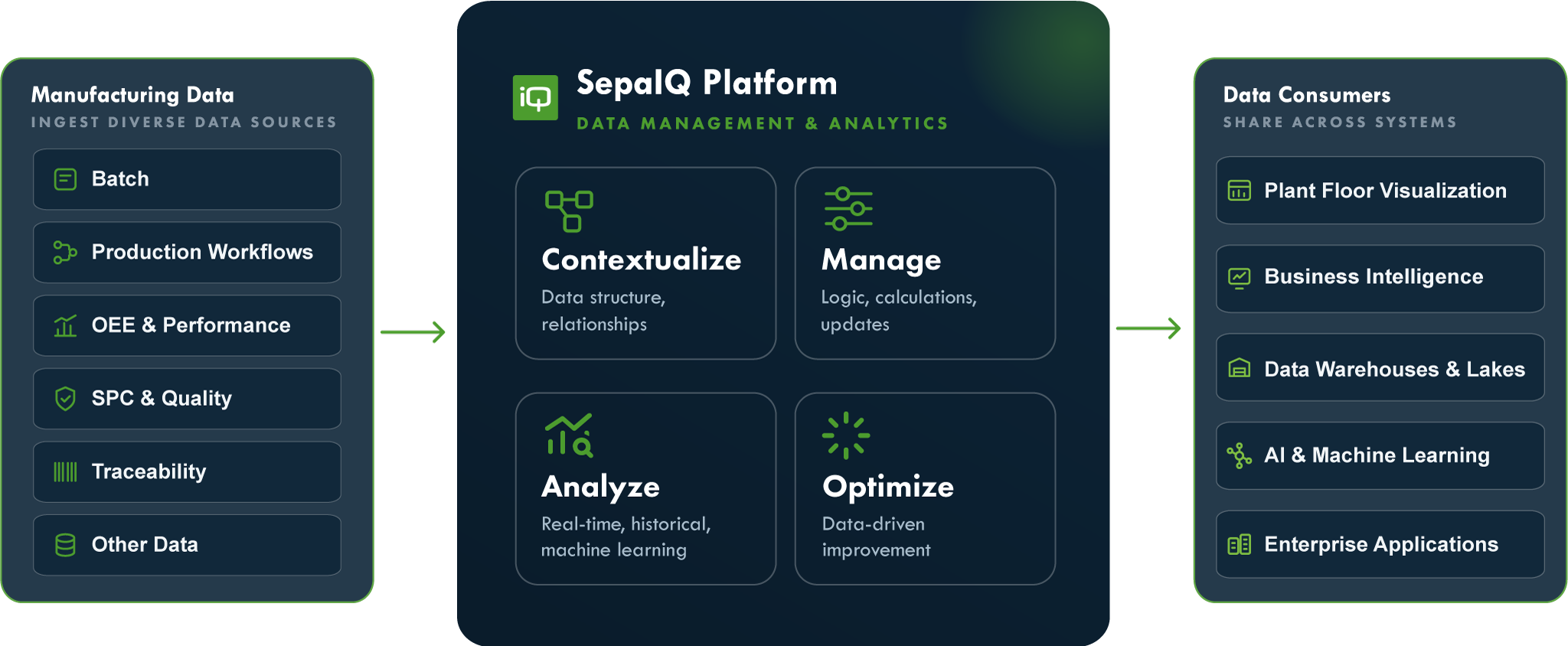
Connect, Contextualize, Analyze
Turn diverse manufacturing data into intelligence your entire organization can use. SepaIQ brings together data from across production, adds operational context, applies reusable logic and analytics, and delivers trusted results to plant-floor and enterprise systems.
Built for the Reality of Manufacturing Data
Handle the scale, complexity, and constant changes of plant-floor information with confidence.
High-Performance Analytics
Critical systems like HMI, SCADA, and MES can push production servers to their limits. SepaIQ offloads analytics to a server cluster, distributing workloads without overburdening production systems.
Post-Production Updates
Manufacturing data is never static. Downtime reasons get corrected, lab results arrive later, and records evolve. SepaIQ saves changes only when values change and keeps related data in sync.
Configurable Data Structure
Structure and contextualize manufacturing data around your operation. Build hierarchies using ISA-95, a modified standard, or a custom framework that reflects how your organization is actually structured.
Real-Time Plant Floor Updates
Connect SepaIQ with Ignition® by Inductive Automation to deliver analytics results back to the people who can act on them in real time and respond more quickly to emerging issues.
SepaIQ Platform & Modules
Start with the SepaIQ Platform, then add enterprise, connectivity, and AI capabilities as your requirements evolve.
SepaIQ Platform
Analytics foundation where data is shaped, calculations run, and all customized analysis is made possible.
- Build custom KPIs, calculations, and reusable analytics logic
- Standardize analytics across lines and sites
Enterprise Module
Designed for growing teams that need structured access, reliable change tracking, and controlled deployments.
- Manage project-based access controls for teams and workspaces
- Deploy updates with review, rollback, and accountability
Incoming Connector Module
Ingest event-driven data from external systems using Kafka, MQTT, and other protocols.
- Stream data from a wide variety of production data sources
- Combine production, quality, and enterprise events in one place
Outgoing Connector Module
Deliver SepaIQ results and event data to external systems using Kafka and Azure event services.
- Send formatted analysis results directly to AI and BI platforms
- Share structured, event-ready data with downstream consumers
Machine Learning Module
Build, train, and run machine learning models using clean, contextualized production data.
- Predict production loss and quality issues before they occur
- Analyze operator notes to detect trends or concerns early
LLM Module
Make production data easier to use with a chat-style interface for questions and summaries.
- Ask natural-language questions about production, downtime, or quality
- Create clear summaries of batches, shifts, and recent events
Explore SepaIQ
Watch the platform in action, explore licensing options, or dive deeper into manufacturing data architecture.
Watch the Demo
See SepaIQ contextualize raw production data, manage updates, and publish trusted results.
Pricing & Licensing
Explore our flexible pricing. Mix and match the specific modules and server scale that fit your project.
MES Context & UNS
Learn how incorporating MES context unlocks the true value of your Unified Namespace.
SepaIQ Platform
Required with every SepaIQ module purchase.
The SepaIQ foundation built for high-performance manufacturing analytics, including custom calculations, unlimited flexible data groups, reusable templates, and more.
FEATURE
dESCRIPTION

Limited by server performance and available system resources
UNLIMITED CUSTOM DATA GROUPS
Define unlimited logical groups of production data aligned to your equipment, products, and processes. Organize data using ISA-95 structures, UNS conventions, or custom hierarchies that fit your operations.
CUSTOM CALCULATIONS
Build custom metrics with drag-and-drop tools and basic JavaScript to calculate cycle efficiency, quality ratios, material usage, or any plant-specific KPIs tailored to your operations.
BUILT-IN CALCULATORS
Use pre-defined SPC and OEE calculations to evaluate performance, losses, and variability using consistent, industry-standard metrics.
SEPASOFT MES INTEGRATION
Use the high-quality Batch, OEE, and SPC data from your Sepasoft MES system as the foundation for centralized analytics in SepaIQ.
Supported databases: MySQL, SQL Server, MariaDB, PostgreSQL, Redshift
READ-ONLY DATA GROUPS
Include external data from ERP, quality, historian systems, and databases as read-only inputs so production, quality, and business data can be analyzed together.
Supported databases: MySQL, SQL Server, MariaDB, PostgreSQL, Redshift
EXTERNAL DATABASE PUBLISHING
ACCESS MANAGEMENT
REST API INTERFACE
Enable full bidirectional interaction with SepalQ. Beyond simple data ingestion, external systems can subscribe to analytics requests, modify historical records, and query the LLM directly.
USER TEMPLATES
Save common data group designs or analysis setups as templates so teams can reuse proven configurations throughout lines, products, and sites.
NATIVE IGNITION INTEGRATION
Connect Ignition and SepaIQ directly to offload centralized analytics from plant-floor systems while returning calculated results to Ignition in real time.
Enterprise Module
Scale securely to multiple sites and teams with project-based access, CI/CD-ready deployment management, and robust change tracking.
FEATURE
dESCRIPTION
PROJECT-BASED ACCESS CONTROL
Assign users to specific workspaces so they only see the data groups associated with that project. Analytics and LLM responses stay limited to the data each person is authorized to access.
PROJECT-BASED RESOURCES
Assign data groups, models, connectors, and templates to specific workspaces so each project has its own clear set of resources. This keeps analysis, data flows, and configurations organized and separated between projects or sites.
CI/CD SUPPORT
Manage configuration changes across development, test, and production environments using repositories (e.g., Git) for secure, versioned deployment workflows.
Incoming Connector Module
Stream MES, quality, maintenance, and external production data into SepaIQ using Kafka, MQTT, and other event-driven protocols.
FEATURE
dESCRIPTION
SPARKPLUG CONNECTOR
Subscribe to Sparkplug MQTT topics so SepaIQ can consume structured, stateful messages from SCADA and edge devices.
KAFKA CONNECTOR
Ingest high-throughput event streams from Kafka topics so large volumes of time-series data arrive in SepaIQ with minimal latency.
MQTT V3 CONNECTOR
Consume MQTT v3 topics from brokers such as a Unified Namespace so sensor and MES events stream directly into SepaIQ.
Outgoing Connector Module
Send contextualized production data and analytics results to external systems through supported event-driven connectors, enabling real-time integration with BI, AI, and cloud platforms.
FEATURE
dESCRIPTION
KAFKA CONNECTOR
Publish high-throughput event streams from SepaIQ to Kafka topics so data lakes, pipelines, and enterprise systems can consume analytics-ready information with minimal latency.
AZURE EVENT GRID CONNECTOR
Push SepaIQ updates into Azure Event Grid so cloud services, serverless functions, and business applications can react to production events in real time.
Machine Learning Module
Build and run predictive models that look for patterns in production data to flag early signs of downtime, losses, quality risks, and process deviations before they affect performance.
FEATURE
dESCRIPTION
BUILT-IN PREDICTION MODELS
Use built-in ML models to predict losses, failures, and quality issues without needing to design algorithms from scratch.
MODEL TUNING & TRAINING
Evaluate how a model performs on real production data using clear training results and scoring metrics. Fine-tune and retrain the model to improve accuracy and confidence before relying on predictions in operational decisions.
SEAMLESS INTEGRATION WITH ANALYSIS
Run prediction models directly within analysis to keep results tied to the same data, filters, and calculations teams already trust. This makes predictions easier to validate, compare, and use without switching tools or reworking data.
LLM Module
Integrate with large language models, enabling teams to ask plain-language questions and quickly get accurate, data-backed explanations of production events, issues, and trends.
FEATURE
dESCRIPTION
GENERATIVE AI & LLM INTEGRATION
Leverage SepaIQ’s native LLM-ready data model to enable conversational analytics without building custom pipelines, prompts, or data-preparation workflows.
CONVERSATIONAL ANALYTICS
Let teams explore production data using natural language instead of queries, scripts, or dashboards.
SECURE LLM ACCESS
SepaIQ acts as the intermediary between your production data and the LLM. Sensitive data stays inside your environment, and only authorized information is sent to or used by the model.
LLM REQUEST REVIEW & VALIDATION
Insert a scripting layer between the LLM and SepaIQ analysis to review and adjust requests before they run. This allows teams to enforce rules, standardize formats, and keep LLM-driven analysis aligned with approved analytics behavior.
LLM ACCESS CONTROL
Define which analysis parameters the LLM can reference or modify when running analysis. This helps limit access to sensitive properties, prevent misleading queries, and keep AI-generated results consistent with approved reporting and analysis practices.
MULTI-LINGUAL SUPPORT
Support decision-making across multi-national facilities by enabling users to interact with the same underlying data model using their local language.